

Leeds University
Leeds University Monitoring Interview
Leeds University Monitoring Interview
Evaluation report on workshops at University of Leeds for Communication Access UK pilot
Communication Matters has been delighted to partner with Leeds University to pilot the training package for the Communication Access UK project.
The University of Leeds has hosted the Communication Matters annual conference since 2013. This conference attracts up to 400 delegates including up to 50 people with speech, language and communication needs (SLCN) who may or may not use Augmentative and Alternative Communication (AAC). The events team had become progressively more aware of the need for enhanced training for staff to ensure they were able to offer appropriate support.
Four workshops with 16-18 delegates at each were delivered to staff at Leeds University during March 2017. The workshops ran for 3 hours each during the morning and afternoons of March 9th and March 21st 2017. Topics covered included what is communication, causes of communication difficulties, identifying what makes a good communication interaction and resources to support communication in the workplace.
Staff who attended were predominantly from Catering Services, Conference Office, Disability Services, Equal Ops and Residential Services.
The venue was the meeting room in Storm Jameson Hall at the University which was set up in theatre style.
The presenters were Catherine Harris (project co-ordinator for Communication Access UK) assisted by Nathan Popple, Sam Knapp and Helen Quiller who all use Augmentative and Alternative Communication (AAC). They had previously received training as mystery customers and workshop presenters.
Delegates were asked to rate the Venue, Timing, Content, Presentation style, Visual Aids and Handouts on a 0-5 rating scale. Scores represented are averaged from all delegates in each workshop.
The feedback from each workshop was as follows:
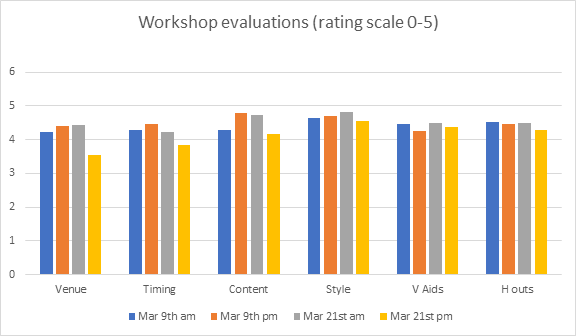
The feedback was very encouraging with all but one delegate reporting that they had valued the content and had learned new things. The content and presentation style was appreciated and seemed appropriate for the delegate profile. The opportunity to hear from AAC users was cited as being one of the most useful elements of the session. There was constructive feedback about the visual aids and handouts and these were slightly amended between the 2 days of the workshops. Although most delegates felt the timing was about right it was felt that the content could be delivered in a 2-hour workshop, which might be more manageable for businesses to facilitate. Once the symbol has been selected, input and participation around the symbol consultation would not be required within the session. Overall there was an agreement that the room was rather small and therefore became rather stuffy especially on March 21st for the pm session. It was suggested that if a larger room was used then it could be laid out in a café style which would suit the partner and group discussion elements of the content. It was good to have coffee and tea provided both before and during the session.
Selected comments from participants
‘Ice breaker was really good to highlight just how difficult non-verbal communication can be’
‘Ice breaker was a bit awkward!’
‘Video of good practice was especially useful’
‘Opened my eyes to how communication can be improved’
‘Useful quick fixes’
‘All of it was helpful-good to be challenged especially if you fancy yourself as a good communicator!’
‘Make sure you have paper and pen to write things down’
Learning points
Not to be afraid to ask someone their preferred communication method
Importance of waiting til someone has finished
Being patient-realising how long it takes for someone using AAC to communicate in ‘real time’
Not worrying about asking someone to repeat
Value of good signage
Establishing how someone with a communication difficulty indicates Yes and No
Need to look at your own service with fresh eyes to see what could improve
It would be good to include training on managing phone queries as well as face to face
Comments
‘More on role of support workers’
‘More from AAC users’
‘This is an exciting project and it is good to be part of it’
‘We talk about equality of access etc but communication is equally important’
‘All very relevant to service-orientated businesses and organisations’
‘Thankyou – it is vital that projects like this exist!’
Subsequent workshops
An additional specific workshop for security staff was delivered prior to the CM annual conference in September 2017. This was more focussed around scenarios. Two additional CAUK workshops were facilitated on May 15th 2018. Following the feedback from previous workshops length of the workshop was slightly reduced to 2 hours. The optimum number of attendees for a face to face workshop was found to be 10-15 to ensure that everyone had an opportunity to participate. Staff attended from security, hospitality, events and management teams. There was more focus on sharing experiences and increased content from the AAC users.
For the morning workshop there was one AAC user and for the afternoon two were involved. The sessions were facilitated by the CAUK project coordinator.
The programme was as follows:
- Welcome and Introductions
- Icebreaker activity (communication without speech)
- What is communication? (reinforcing total communication)
- Conditions which impact on communication (sharing experiences)
- Communication Access UK (symbol and standards)
- Monitoring framework
- Questions and evaluation
The sessions were evaluated as previously. There were a total of 20 delegates (19 from the university and one support worker who completed the evaluations) Scoring out of 5
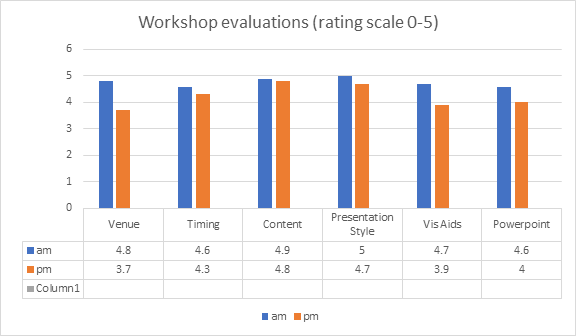
Qualitative responses
Most helpful
17 people sited that the involvement of an AAC user was central to the impact of the session.
Least helpful
Background to developing symbol. Would be nice to have a UK version of the film
What have you learned about CAUK
Background to Consultation. Need for UK adoption. Symbol has underpinning standards
Learning point to take away
Importance of time, patience, ask how best to communicate. Establish Yes/ Ask for repetition
Other comments
Request for a short summary handout to use when cascading information to staff teams. Discussion around potential acronyms to support training. Preferred acronym was TALK (TIME, ASK, LISTEN, KEEP TRYING) other acronyms discussed were SPEAK and RESPECT.
CONCLUSION
In total over 100 staff have now attended the pilot training workshops and have contributed to the development of appropriate resources. It has been reported by managers that the face to face model in this setting has been valuable for the teams represented. Further workshops have been requested in the autumn 2018.
There would be support for an online e learning resource although it is recognised that the topic of communication lends itself particularly well to group learning so experiences can be shared.
Following this pilot training, and once the symbol has been soft launched, resources will be further tested with ‘early adopters’. An early adopter is an organisation who will receive training, display the symbol and help to measure impact. Early adopters have been identified in AAC assessment hubs, Health Trusts, Specialist education Centres and a local high street. Gaining support from a larger corporate will be key to the success of the next stage.
Communication Access UK is a vision that continues to receive positive support from key stakeholders including people with communication difficulties, Speech and Language Therapists and service delivery organisations and businesses. The aim is progress, not perfection, changing attitudes and culture towards a more inclusive society for all.
Catherine Harris
Communication Matters Project Worker for CAUK
July 2018
